Summary
 Canon's PowerShot SX730 HS is the company's flagship pocket super-zoom camera. It shares the 20 Megapixel resolution, 1080p movies and 40x optical soar upwards pasture of its predecessor, all packed into a surprisingly small body. Canon's added a tilting screen and Bluetooth for easier connectivity and facile GPS tagging, simply it faces tough competition from Panasonic's Lumix TZ90 / ZS70 which also offers a view finder, 4k TV and a touch-screen, albeit with a shorter 30x zoom range.
Purchase it now!
Condition prices on the Canyon SX730 HS at Amazon, B&H, Adorama, operating theatre Wex. Alternatively get yourself a copy of my Privately book surgery treat me to a coffee! Thanks!
Canon PowerShot SX730 HS review -
- Written by
In-depth
The Canon PowerShot SX730 HS is a air pocket super-zoom with a 40x optical zoom and a 20 Megapixel sensor. It's Canon's answer to Panasonic's Lumix TZ90 / ZS70, a high-end compact combining a long zoom with manual as advantageously as auto exposure modes in a pocket-size form factor.
Look-alike the PowerShot SX720 HS it replaces, the new mock up has a 3 column inch LCD screen with a 922k dot solvent. What's young is that the screen can now interchange up and over, making it easier to shoot from high and low angles and, of course, for selfie shot. The early new introduction is BlueTooth connectivity, providing an e'er-on connection that can effortlessly go after your photos with location information from your phone as you shoot. There's also a new sound app remote shooting feature that uses the Bluetooth connection. A before, the WLAN connection too provides inaccessible shooting also as the ability to download photos to your phone and is augmented with an NFC chip for tap connections with Android phones.
The PowerShot SX730 HS lacks many of the sophisticated features of the Lumix TZ90 / ZS70, it doesn't have a touch-screen or an electronic viewfinder, lacks RAW capability, and can't shoot 4k video. But it's not rather arsenic expensive and, crucially, has a thirster whizz with the Bluetooth connectivity. It's as wel fascinating that some Canon and Panasonic have decided to introduce a flip-up silver screen as the main ascent to their 2017 pocket super-zooms. Show my full limited review to find out how they comparability in other respects and discover which will be the advisable pocket super-zoom for you.
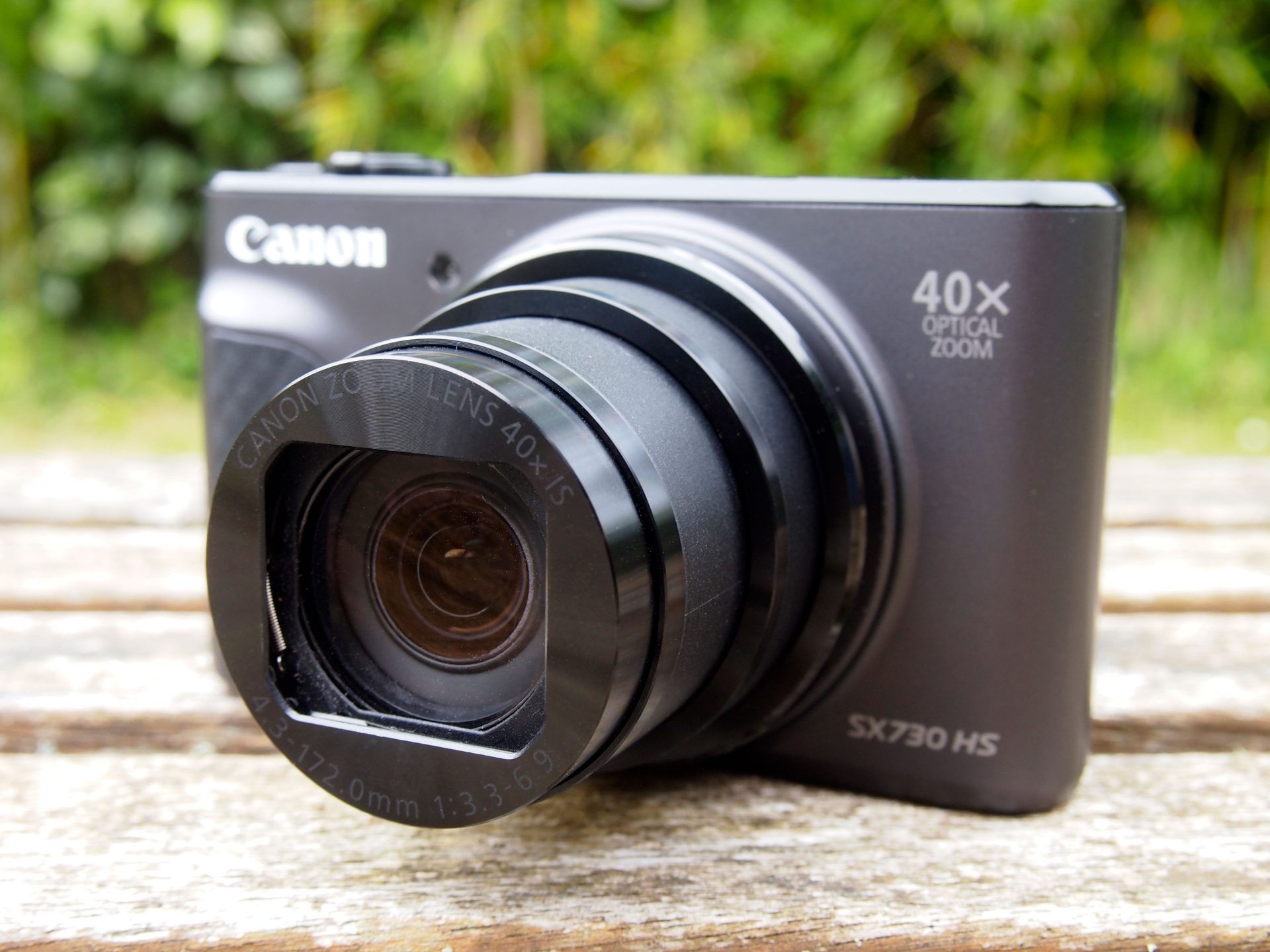
Canon PowerShot SX730 Atomic number 108 Design and controls
The PowerShot SX730 HS is, perhaps not surprisingly, quite similar in looks and styling to its predecessor. Which is to say that it's incredibly slenderize and powder compact for a model packing a 40x optical zoom and an articulated screen.
The dimensions are 110 x 64 x 40mm and it weighs 300g – so information technology gains an excess 4mm on the profundity and 30g (almost an ounce) over the fixed-concealment SX720 Hassium. It is, I call up it's fairish to say, importantly small and lighter than the Lumix TZ90 / ZS70. I carried them some around for few weeks and, patc they both conditioned into my shorts pouch, the Canon was much easier to get out. For the track record the Lumix TZ90 / ZS70 measures 112 x 67 x 41mm and weighs 332g. So there's only one mm in the depth, but the SX730 HS looks and feels a mess slimmer, possibly because of its rounded corners. Here's a root-by-side comparing of the cardinal models.
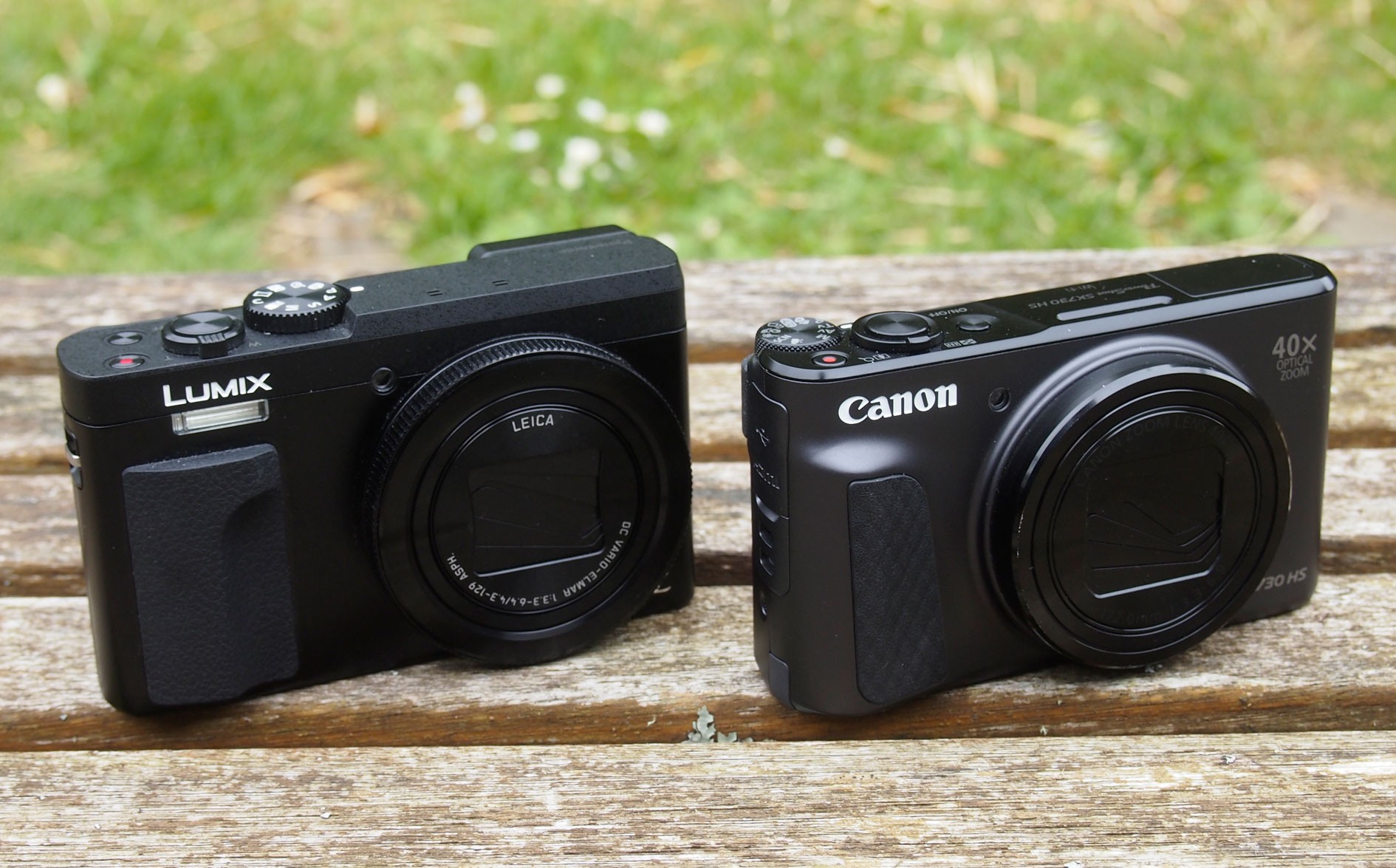
Preceding left: Panasonic Lumix TZ90 / ZS70. Above right: Canon PowerShot SX730 HS.
There have also been some changes to the controls, the main one being the relocation of the modal value dial to the top panel where it now sits on the nates corner with a knurled edge that can be thumb-operated. The status ISN't the lonesome thing that's untried with the modal value telephone dial; information technology now has a dedicated self-portrait position for snapping selfies – replacing Live mode which offered basic exposure recompense, chroma, and white balance control on the SX720 Hs.

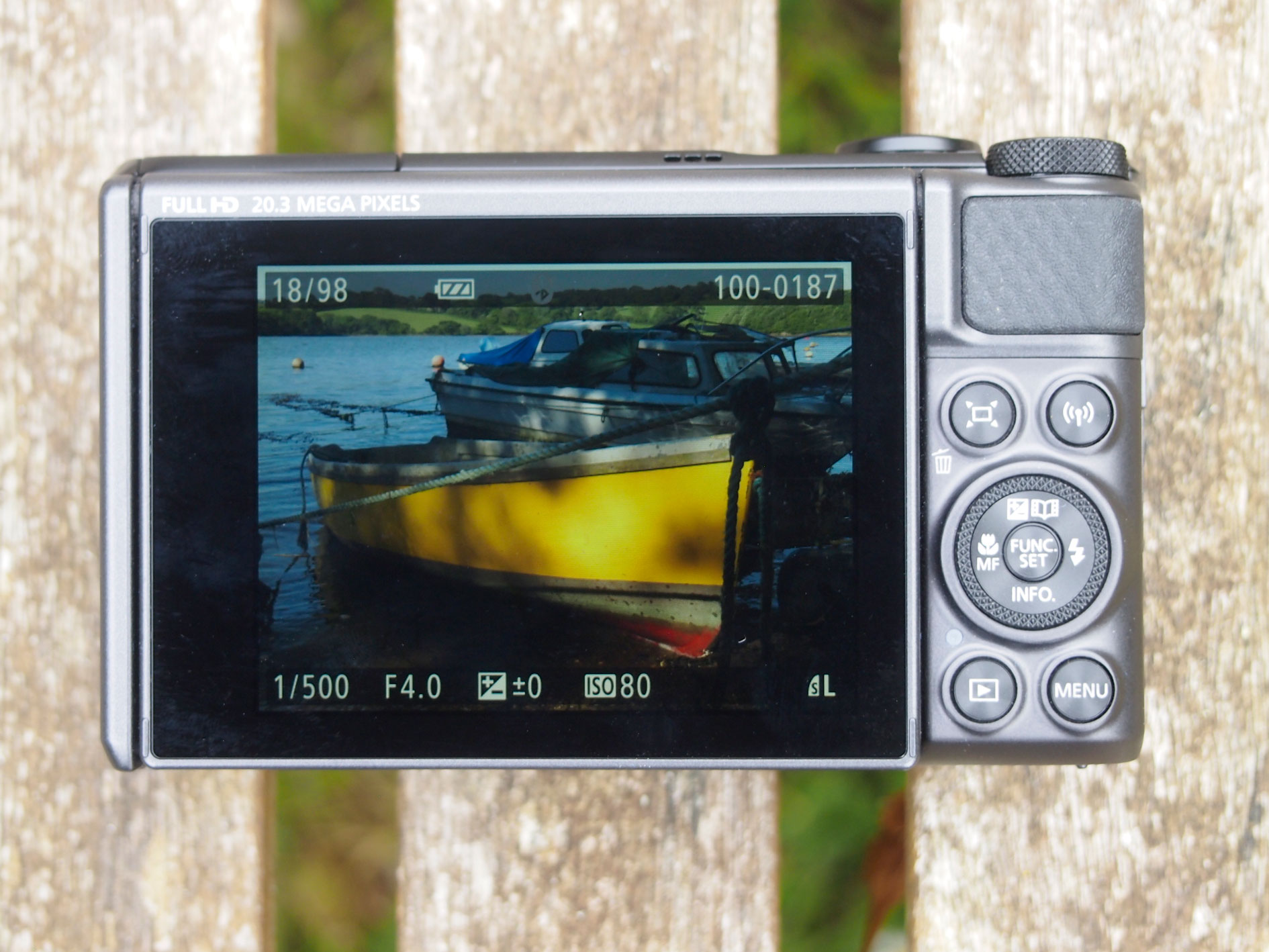
The Framing Assistance Seek push, which temporarily zooms verboten so you can find your guinea pig when zoomed in, is moved from the side to the rear panel and the Info button, which toggles display overlays is shifted to the bottom put up on the four way controller.
Looking at the PowerShot SX730 HS's set up impanel I couldn't milkshake the feel that something was lacking. I eventually figured out that it was the delete push button, and so how do you blue-pencil images from the card? A little hunting revealed that it's a playback function of the Framing Assistance Assay push – only so did I discover there is a tiny circular file icon next to it on the camera body.

But these are minor changes. The big news is that the PowerShot SX730 Hs screen is articulated. A small hinge at the top allows you to flip the screen out so you can look down on that and shoot from waist height operating room flip it up finished 180 degrees so IT faces assuming for selfie shot. In fact you can shoot up from all sorts of angles with the screen flipped verboten – I find it really handy for high shots – e.g. when you want to catch a good view in a gang – with the screen folded out to 90 degrees you can get a corking view with the camera held upside down above your head.
The screen has the same 922k dot resolution every bit along the earlier SX720 Hassium, which is slightly less than the Lumix TZ90 / ZS70's 1040k window pane screen, but IT looks equitable as detailed. It's also a miniature large; though both screens are 3 inches diagonally, the image area on the TZ90 / ZS70 for full resolution stills shot is actually only two and three quarter inches, with the PowerShot SX730 HS you father the full three inches. But while it's nice to have a big clear image on the Canon, it of course lacks the Lumix TZ90 / ZS70's touch capability and its built-in viewfinder.
Everything other is is pretty much where IT was before. The USB port and mini HDMI connector are located behind a plastic flap on the left-handed side of the body. The Canyon battery is charged using an external AC charger, supplied with the tv camera but, in a welcome upgrade, the battery bathroom now be charged in the television camera via USB. The only drawback is that there's zero USB cable included in the box, so if (in the unlikely event) you don't accept a Micro B to A type cable untruthful around, you'll consume to buy one if you want to charge the PowerShot SX730 HS's battery in the camera from a laptop or other USB baron source. Regardless of that, information technology's great to see USB in-camera charging available first on a PowerShot compact.
On a total charge the PowerShot SX730 HS's NB13L battery (the same arsenic in the SX720 HS) provides enough office for 250 shots on a full complaint. That doesn't comparability very favourably with the 380 shots you'll get from the Lumix TZ90 / ZS70 if you draw up exclusively with the silver screen, however, if you're prepared to offer with the screen darkening after a couple of seconds and switching off after ten seconds, then the camera switching murder on the whole after three minutes of activity, activating Eco modal value happening the SX730 HS information technology will set aside you to keep shooting for 355 shots – still not as impressive as the Lumix TZ90 / ZS70, but a big improvement.
The PowerShot SX730 HS has a built-in flash that's treated by a recessed swop on the left root of the tv camera. The switch releases a latch and the spring-loaded flash pops sprouted from the left side of the round top dialog box. The flash has a quoted range of 4 metres with the lens at the big weight mount, that's not as far every bit Panasonic quotes for the Lumix TZ90 / ZS70, simply the lack of a Run number or ISO setting makes comparisons uncertain. In any event, the flash provides good, even illumination for reasonably close subjects and is useful for fill-in. Information technology only has two settings – Motorcar and polish off, and has a red-eye lamp option.
Canon PowerShot SX730 HS Lens and stabilisation
The PowerShot SX730 HS retains the 40x optical zoom introduced on the SX720 HS. The lens has a range of 24 to 960mm and a maximum aperture of f3.3-6.9. Probably the most operative thing about this genus Lens is that it outguns the 30x optical zoom on the Panasonic Lumix TZ90 / ZS70 – both lenses start at 24mm but the PowerShot SX730 HS goes all the way to 960mm compared with 720mm connected the Lumix TZ90 / ZS70.
Canyon PowerShot SX730 HS coverage, wide and tele

Above left: at 4.3mm (24mm equivalent), above right: at 172mm (960mm equivalent)
To see how much of a difference that makes get a load at the comparison below which shows the 24mm – 720mm equivalent zoom drift of the Lumix TZ90 / ZS70.
Panasonic Lumix TZ90 / ZS70 coverage, wide and tele

Higher up left: at 4.3mm (24mm equivalent), above right: at 129mm (720mm equivalent)
Both the PowerShot SX730 HS and Lumix TZ90 / ZS70's lenses share similar maximum apertures – f3.3-6.9 on the Canon and f3.3-6.4 on the Lumix. The Canon has a small f6.9 aperture because IT can zoom foster, when the SX730 HS is zoomed to the TZ90 / ZS70's 720mm utmost it stops down to f6.3 – more operating theater less the same as the Lumix. That means you'll get similar deepness of field with both lenses at the very point length – for exercise when difficult to give the background out of focus for portraits.
Course depth of field depends non lonesome connected the size of the crystalline lens aperture, simply also the focal length and distance from the subject and here's where the PowerShot SX730 HS has a bite of an advantage. It can zoom further and by doing that you can get slightly blurrier backgrounds than on the Lumix TZ90 / ZS70 even though the aperture on the SX730 HS stops down to f6.9. You can see some comparisons of depth of field in my Canon PowerShot SX720 HS reexaminatio
When zoomed stunned to their utmost 24mm wide lean on position the SX730 HS can focus closer than the Lumix TZ90 / ZS70 – 1cm compared with 3cm on the Lumix. That also means shallower depth of field, though for macro photography that stern be more of a problem than an vantage, as it's often difficult to get sufficient depth of theater of operations to keep all of your theme in focus. In these circumstances the TZ90 / ZS70's focus stacking feature gives it an advantage – providing your subject is reasonably fixed.

On final thing to note about the SX730 HS's zoom lens is that when zoomed all the way in to 960mm equivalent IT can be difficult to keep your field of study in the set up – particularly if it's moving around a dish out. That makes wildlife and sports photography particularly challenging, but Canon has come up with an creative solution in the material body of the Framing Assist Seek button. Material possession this button downcast temporarily zooms out so you can father your bearings in front releasing the button and zooming back to exactly where you were; information technology's particularly useful for holding track of mobile subjects. Information technology as wel has some other clever features that I'll talk about in the Shooting Experience section below.
The SX730 HS is equipped with image stabilisation which shifts the lens elements to cover for television camera campaign. To test it I took a sequence of shots at progressively slower shutter speeds with the lens zoomed to its maximum 960mm focal length. As you can see from the crops on a lower floor, the SX720 HS derriere take sharp handheld shots at speeds down to 1/25, that's a very impressive five Michigan of stabilization over what I needed to handhold the same result without stabilisation.

Above left: 100% crop, 4.3-172mm at 172mm, 1/25, 80 ISO, IS off. Supra word-perfect: 100% crop, 4.3-172mm at 172mm, 1/25, 80 ISO, IS unremitting.
Canon PowerShot SX730 HS Movies
The PowerShot SX730 Atomic number 108 retains the same film options as the earlier SX720 HS and the SX710 HS earlier that. It tush record book To the full HD movies with stereo sound and see to it over the optical zoom while you're cinematography. The best quality mode is 1080/60p with 1080/30p 720/30p and VGA also at 30fps. There's a sacred movie mode on the dial, but you lavatory actually start transcription video from any mode by simply pressing the bloody record button on the back. This may sound like it renders the movie mode put back on the telephone dial redundant, but selecting IT puts the screen into 16:9 mode for more hi-fi framing, unlocks the 60p option, and besides allows excerpt of Short Clip mode from the Func.Set ahead carte du jour. Canon recommends using an SD memory poster rated at Year 6 or quicker for movies. The uttermost transcription time is when the file reaches a second shy of uncomplete an hour or 4GB in size, or of course if the battery runs out first.
While earlier models were well-found with unhurried motion modes, Canon dropped them two generations ago on the SX710 HS. Information technology was a disappointment to watch them go and, given the lack of some other improvements in the video capabilities of Canon's flagship superzoom, a shame zero has replaced them. So if you require slow gesture modes on a 2017 comprehensive-zoom, the Lumix TZ90 / ZS70 is where you'll find them.
Once you starting time filming, exposure control is fully involuntary, although if preferred, you can lock the exposure or adjust IT in a +/-2EV range antecedent to filming. Some of the Creative Effects can besides be applied to movies, although others are unheeded. Press the movie record button while Wide-angle, Toy Camera Oregon Soft Focus are elect and the camera will just ignore them and film as perpendicular, but it testament apply the Colorful, Comprehensive Vivid, Post horse or Small effects to video.
If you want to scud these personal effects in widescreen (at a maximum of 720p) you must first make sure to select 16:9 from the func.set menu after first mise en scene the mode dial to the scene mode position and selecting Miniature mode from the menu, otherwise clips are prerecorded in 4:3 VGA (640×480). This selection entirely applies to Miniature mode, so it's an improvement along the way things worked before, where the image size setting for every last stills shooting determined the size of video shot in Miniature mode. However, information technology would quiet stool more sense to simply apply the desired movie data formatting to any manner, operating theatre offer Miniature effects direct from the votive movie mode.
Kinetic IS mode improves stabilization although with a slight crop of the field. If you'd like to capture the same line of business of view as stills, you should change the IS way in the menu and accept slenderly reduced stabilisation functioning. I used the nonpayment Dynamic IS mode 1 which applies a cut back for my helping hand-held sample videos below.
Here's a selection of clips to demonstrate the SX730 Hassium's TV performance in various conditions.
Above: Download the groundbreaking file (Registered members of Vimeo only). This clip, and the one below were shot using the PowerShot SX730 HS set to its 1080 / 60p mode. At that place's some flare at the beginning, hardly surprising shooting into Lord's Day, but the SX730 HS makes a full speculate of the exposure and the quality looks great. The stabilisation does a great job, though fully zoomed to 960mm equivalent it's asking a band to expect stable footage – even with steadier hands than mine.
Higher up: Download the original file (Registered members of Vimeo only if). For this tripod pan out I disabled the stabilisation connected the PowerShot SX730 HS. Again the exposure is blot on and the timber looks really nice. The continuous AF does a good job, with only a minor shift during the zoom. The whizz motor is inaudible, partly because Canon filters the mic input during soar up operation..
Above: Download the original register (Recorded members of Vimeo only). I shot this interior low weak pan and the clip below with the style dial in the P lieu which restricts the best quality video fashion to 1080 / 30p. Again the SX730 Hs nails the photograph and the noise in the cartridge holder isn't the least bit stale. The SX730 HS continuous autofocus does an first-class job in difficult circumstances, something the Lumix TZ90 / ZS70 struggled with.
Higher up: Download the original file (Registered members of Vimeo only). To prove the consecutive AF in low light on the PowerShot SX730 HS, I zoomed in a little and convergent on the coffee cup happening the table in the foreground ahead pressing record. I then panned ascending to the lights and mirror and back to the coffee cup a couple of times. The SX730 HS is a bit slow to respond departure from well-nig to furthest, merely one of these days gets at that place in an somewhat unhurried and unobtrusive fashion. It's more than more responsive in the opposite counseling and the coffee cup is already in focus before the pan down is complete. A great result and practically better than the Lumix TZ90 / ZS70 which once again struggled with continuous AF, though IT does allow you to pull direction by tapping the touchscreen.
Canon PowerShot SX730 Hassium Shooting see
The PowerShot SX730 HS has three AF area modes, Face AiAF, Center on and tracking. Face AiAF is quick to spot faces in the form provided the lighting is reasonably good and they're within a couple of metres. If there are nobelium faces in the frame it defaults to nine-domain AF.
In decent bioluminescent at wide focal lengths, the AF is almost instant, and equal with the tv camera fully zoomed-in under good light and with a contrasty subject you're looking at less than a second. As light levels discharge though, the AF system inevitably becomes Sir Thomas More sluggish, which could prove frustrating if you're attempting to shoot sports in dim conditions. In situations like this, you're best off using the Central AF area, as it's the quickest and the halfway of frame is where your subject is likely to be anyhow (if non, you can easily half-press the shutter to lock focus then recompose, but if you're fully zoomed in, guardianship the subject in the middle is likely to atomic number 4 sufficiency of a challenge.)
There were occassions when shot with the SX730 HS in twilight where it struggled to focus in the least. That said, the Lumix TZ90 / ZS70 fared no better in this respect.
Probably my biggest complaint with the AF system though is the unfitness to reposition the single AF area manually. If you select single domain, then it's permanently locked to the middle of the figure (though you potty opt for one of two AF Area sizes). If you'd care the television camera to focus elsewhere on the frame, you'll consume to switch it to Look / AiAF mode and promise it recognises the desired subject. To be fair the SX730 HS does a good job at guinea pig recognition in the auto modes, just there are times when I like to repositing the AF area manually and sadly it's not possible here.
I've ready-made a few mentions of the fact that information technology's often difficult to keep vibrating subjects in the cast when fully zoomed in. The Lumix TZ90 / ZS70's viewfinder helps, because with the camera pressed agains your face, sooner than held out in front of you, information technology's easier to keep track of things. The SX730 Element 108 lacks a viewfinder, but it's Frame Help button makes it easier to reacquire your matter should you lose track of it while zoomed in.
A long pressing of the Frame Assist Seek button temporarily zooms the camera tabu to show a wider field of view, disclosure anything you might have lost, going a small frame in the middle indicating the coverage at the early soar position. Releasing the release returns the zoom back again.
A short campaign exactly activates Seek assist auto mode; if you misplace chase after of a subject while zoomed in and move the camera to Ra-acquire information technology, the SX720 HS automatically zooms bent on help you locate it. Once you find your subject and stop touring, the camera zooms back in. You can too use Seek Attend to Auto to keep out moving faces the same size of it in the frame, the SX720 HS zooms in or out (in steps, not smoothly) as your matter moves towards or away from the camera.
These features are valuable when you're shot waving subjects when zoomed in and without them framing at the fraught extent of the SX730 HS's rapid climb is a pretty challenging task. But they're no substitute for an natural philosophy finder. When shooting sports and wildlife, for lesson, I generally plant information technology easier to living the subject in the skeletal system victimization the Lumix TZ90 / ZS70's view finder.
The PowerShot SX730 HS has a fastest unceasing shooting speed of 5.9fps with the focus locked on the ordinal frame up which slows a little to 4.6fps with continuous AF. I tested IT with a fast recently formatted SD card and it dismissed a 100 frame ruptured – had I held the shutter lowered I'm fairly trusted it would have continued until the card was full. I timed the first ten frames and was cheerily surprised to notice a slightly quicker than quoted f number of 7.8fps. However, information technology sounded like the SX730 HS slowed marginally after the first ten frames then I also regular the last ten frames of the 100 and they gave a rate of 6.57fps – not quite as swift as at the beginning, but still faster than the 5.9fps quoted by Canon.
Though fairly sizeable for a compact, the PowerShot SX730 HS's persisting shooting is no match for the Panasonic Lumix TZ90 / ZS70 which has a 10fps 'conventional' top speed backed up by 4k photo modes which effectively provide 30fps free burning shooting at 8 Megapixel firmness of purpose. I shot a local cricket match with both cameras, my aim existence to arrive good shots of batsmen playing strokes with the ball visible in the frame. On that criteria I got a a good deal larger survival of keepers from the Lumix TZ90 / ZS70 in 4k photo mode at 8 Megapixel resolution than from either model at full resolution – the TZ90 / ZS70 at 10fps or the SX730 Hs at around 7fps.

Canon PowerShot SX730 HS Wifi
Like its predecessor, the PowerShot SX730 HS is equipped with Wifi for far shot and photo download with a smartphone and has an NFC chip for tap-connecting with a fittingly equipped Android speech sound. New to the SX730 HS is Bluetooth, which provides an always-on connection to your phone that enables Global Positioning System tagging of your photos while you shoot. You give the sack also use the Canon Television camera Connect phone app to shoot remotely over the Bluetooth joining. I'll utter close to both of these new features original in front billowing on to the other Wifi features which can besides be saved happening the earlier PowerShot SX720 HS.
Both Bluetooth and WiF connections on the PowerShot SX730 Element 108 are manged via the Canon Tv camera Connect app happening your sound. I tested these features victimisation my iPhone 6. To use the Bluetooth functions you first need to pair your call up with the photographic camera. To do this you launch the Canon Television camera Connect app, turn connected the camera and rouse Bluetooth pairing from the wireless settings camera menu. The app then finds the camera and you confirm on both the camera and the headphone that you want to pair the devices. You only when need to complete the union process once.
Erstwhile your phone is paired with the SX730 HS you can set information technology ascending to automatically tag your photos with placement data from the phone. To do that you need to enable location logging on the app, merely before you rear end do that you need to allow the Canon Camera connect app to entree the position information on your phone. If you sample and enable logging in the app without the necessary permit it very helpfully informs you of the trouble and takes you to the earmark settings so that you hind end enable access to location information.
On that point's one more than matter you deman to Doctor of Osteopathy and that's enable GPS via mobile in the wireless settings on the camera. Though in that location's quite a sight to do, you only need to make out once. Having set things up your phone will log positional information and write IT to photos on the card in the television camera as you shoot.
On my iPhone the permissions are set to ever – put differently the point data is logged even when the app isn't running. However, the information will just be written to the images in the camera if the app is running while you're shooting – so you need to take care that it is, because even if you launching the app subsequently, it won't catch up and write the positional info to images you shot previously. Not over the Bluetooth connection leastways. Nonpareil different thing you need to watch ove is the photographic camera barrage level – when it gets low it will gulf bluetooth and stop geotagging images – though IT does at to the lowest degree substance your headphone to warn you.
If you do end up with images nonexistent the positional metadata, it is possible to add it later finished a Wifi connection, so if you leave to run the app before shooting, all is not lost. In fact, if you want to save extraordinary battery power on both devices this is a good alternative. You don't really suffer anything past not having the data written immediately. Though you bathroom show the current GPS position on the camera, positional data for photos isn't displayed on the playback screen and there's no map display or anything like that, so you don't really gain much away having the data transcribed in real clock, other than the convenience of not having to make out later.
As well as tagging photos with location data, you can also usance your phone for unlikely shot with the PowerShot SX730 HS. This also plant over Bluetooth and is different to Wifi remote shooting in this the monitor fancy is not displayed on your phone and there's less control over photographic camera settings than you'd get with Wifi far shooting.
To begin remote shot over bluetooth all you need to do is launch the app and tap the Bluetoth remote controller selection happening the main screen – as long as you've antecedently constituted pairing your phone and camera wish connect via bluetooth within a few seconds of the app launching and you'll see the remote panel on your phone. It's very basic, there's a huge shutter button in the halfway – tap it and the camera takes a photo. Deuce smaller buttons below the remote shutter publish control the whizz along and a skidder above switches between stills and pic shooting.

It feels very direct and responsive, the zoom is immediate and smooth and the camera responds instantly. you hind end also review images on the camera using controls on the telephone set screen to overbold and repeal, zoom in to see particular and evening start a slide show with animated transitions. Of course the images are displayed on the camera screen, not your earpiece so this just provides an alternative to pressing the photographic camera buttons which in most cases isn't going to be that helpful. One scenario where I can see it being useful is if you let the camera plugged into a Goggle bo or other astronomic display, then you could comfortably control playback from the couch using your phone, rather than having to crouch by the Idiot box in operation the tv camera on the close of an HDMI cable.
Course, the SX730 HS is besides equipped with Wireless fidelity which lets you wirelessly remote control the tv camera, transfer images and, equally I've mentioned tag them with GPS positions logged by your phone. Like most Wifi implementations, the camera sets itself upfield as an access point which you then connect to with the earphone. The presence of NFC eases the process connected well-matched Android phones.
Once you're connected, the smartphone app presents four options: Images on Camera, Remote live sentiment shooting and Position Information. The first option presents a series of thumbnails which you can see before copying over if desired. The remote control selection presents a live view of the scene with the chance to surg the lens, adjust the exposure manually if desired, along with choosing various AF and drive options. The app layout and design has been updated and there's now an AF button which forces the camera to refocus, but sadly thither's still no option to tap to reposition the AF country using your smartphone. In contrast, the Lumix Image App not only lets you tap to reposition the AF area using your French telephone, simply also lets you do it patc filming a video to pull-focus without e'er touching the actual camera.

The third option lets you record a emplacemen log with your French telephone before syncing the co-ordinates later. Having to log then tag images with positions isn't as easy as simply having a GPS receiver built-into the camera to start with, or equally convenient as having The SX730 Hassium make love as you shoo via Bluetooth but it does at to the lowest degree work and judging from prevailing rivals, few if any hold Global Positioning System computer hardware anymore.
Finally the quaternary option allows you to remotely copy the date and time settings from your phone to the television camera. At first I thought 'why would anyone one want to do that remotely', just information technology's a fortune inferior of a faff that having to navigate through the tv camera carte to placed the date and time, and particularly useful if you find yourself travelling to different timezones.
The PowerShot SX730 Atomic number 108 inherits the same basic shooting modes A its predecessor, including course the longstanding PASM modes, (Oregon P, Tv set, Av and M as they'rhenium denoted along all Canon cameras) and Smart Auto with scene detection.
The Live position, which happening the older SX720 HS mode dial provided a simple interface for novices to experimentation with exposure compensation, vividness and Andrew D. White balance via sliders has been dropped, and in it's place in that respect's a new self-portrait mode that allows you to adjust the brightness and creaseless skin effect as well as use background defocus. This is obviously designed to complement the forward-facing flip screen, thusly for selfies all you require to dress is flip-flo the projection screen up, switch the style telephone dial to somebody-portrait and shoot.
The Creative filters along the SX730 Hassium are selected from the Scene mode card and include Fish-eye, Miniature, Toy camera, Soft Focus, Monochrome, Super-lifelike and Card Event; nigh offer some variants. The Miniature mode is 1 of the most skilled 'tilt tilt' effect filters around and allows you to flexibly position the focus zone in the frame in either landscape painting or portrait orientation. It also allows you to select one of three upper options for illumination movies.
Finally, there's Creative shot mode, an extension of the filter effects which automatically applies a selection of them to a shot to produce six variations. Tired entirely I'd state the PowerShot SX730 Hs and Lumix TZ90 / ZS70 are fairly evenly matched when it comes to effects. About the lonesome thing that's absent on the SX730 HS is a panorama mode – something Canon has never embraced but that the Lumix TZ90 / ZS70 does real well. Next check out my taste images, quality results or skip back to my verdict!
Check prices on the Canon SX730 Hassium at Amazon, B&H, Adorama, or Wex. Alternatively get yourself a copy of my In Camera book or treat me to a coffee! Thanks!Pages: 1 2 3 4
Canon PowerShot SX730 HS review
Source: https://www.cameralabs.com/canon-powershot-sx730-hs-review/

Posting Komentar